What you are looking at
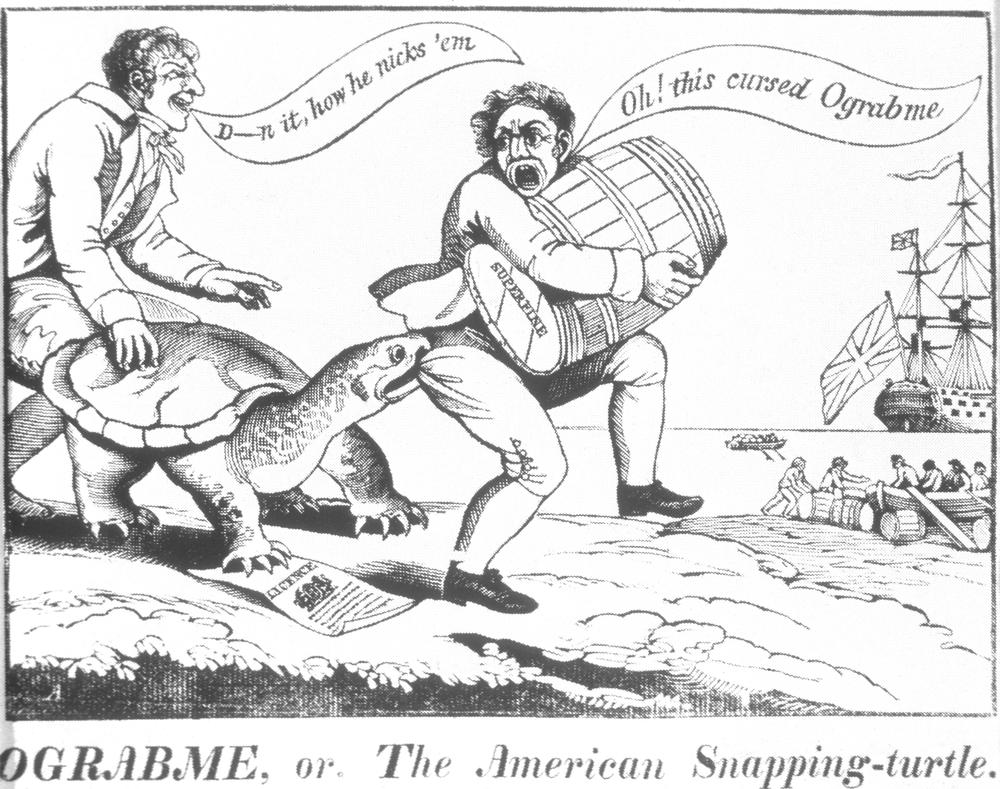
A snapping turtle has a smuggler by the breeches. He is hauling
casks toward a British ship; a boat is already loading barrels
in the surf. A man perched on the turtle’s shell — a customs
officer, or the government itself — says
D—n it, how he nicks ’em.
The trader yells
Oh! this cursed Ograbme.
Ograbme is embargo spelled backwards. Read it aloud and it is also “O, grab me.” The turtle is the law.
The moment
On 22 December 1807 President Thomas Jefferson signed the Embargo Act. American ships were forbidden to sail for foreign ports; foreign ships could not load cargo in American ones. Britain and France, at war, had been seizing U.S. merchantmen and impressing sailors. Jefferson wanted commercial pressure instead of a fight.
The embargo hurt the United States first. Ships sat idle in New England, crops piled up, and smuggling became a sport — which is the scene on this beach. Federalist papers nicknamed the statute Ograbme, also Dambargo, Mob-Rage, and Go-bar-’em. Congress repealed the 1807 act in March 1809. A later wartime embargo (1813) brought the same joke back, which is why image libraries sometimes date this cut 1811 or 1813 instead of 1807.
Artist, author, publisher
Catalogs give the engraving to Alexander Anderson of New York (21 April 1775 – 17 January 1870). His parents were Scottish; his father, John Anderson, was a printer. He taught himself to cut metal as a boy, took a Columbia M.D. in 1796, and served as a physician at the yellow-fever hospital that became Bellevue. The 1798 epidemic killed his father, brother, infant son, then his wife and mother. After that he worked as an engraver. He is often called the father of American wood engraving: Webster’s speller, Bewick’s animals, Shakespeare, tracts, newspapers, and commercial cuts for decades.
Later cartoon histories say Dr. Anderson designed a series of terrapin pictures for the New York publisher David Longworth, and that this O-grab-me was the one that stuck. There is no separate literary author. The palindrome was already a Federalist gag. The plate is not signed the way a later print would be. Indiana University’s cartoon collection, NCpedia, and Granger list Anderson; the attribution is traditional and widely repeated, not a documented signature on this scan.
This scan
Public-domain photograph of the print, circulated via Wikimedia Commons from Indiana University’s Presidential Campaigns: A Cartoon History, 1789–1976 (there, “reprinted with permission from The American Past”). The original engraving is long out of copyright.